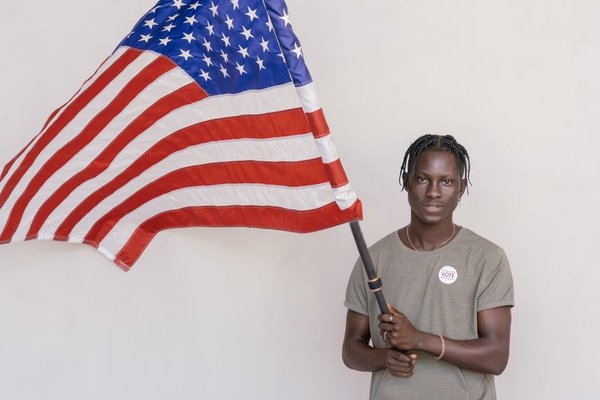

For your U.S. citizenship test in 2026, check your N-400 filing date. Filed before October 20, 2025? The older civics test draws from 100 questions; six of ten correct answers pass. Filed later? The newer test draws from 128 questions; twelve of twenty correct answers pass. This guide covers the older test only.
These shortened practice questions are not verbatim USCIS wording. Verify changing officeholders before interviewing.
American Government: Questions 1–57
1. What is the supreme law? The Constitution.
2. What does the Constitution do? Sets up the government.
3. What are the Constitution’s first three words? We the People.
4. What is a constitutional amendment? A change or addition.
5. What are the first ten amendments called? The Bill of Rights.
6. Name a First Amendment freedom. Freedom of speech.
7. How many constitutional amendments exist? Twenty-seven.
8. What did the Declaration of Independence do? Declared independence from Great Britain.
9. Name two rights in that Declaration. Life and liberty.
10. What is freedom of religion? Practicing any religion or none.
11. What is America’s economic system? A market economy.
12. What is the rule of law? Nobody is above the law.
13. Name one government branch. The legislative branch.
14. What prevents one branch gaining too much power? Checks and balances.
15. Who leads the executive branch? The President.
16. Who makes federal laws? Congress.
17. What are Congress’s two chambers? Senate and House of Representatives.
18. How many U.S. senators serve? One hundred.
19. How long is a senator’s term? Six years.
20. Name one senator from your state. Check your state’s current senators.
21. How many voting House members? Four hundred thirty-five.
22. How long is a representative’s term? Two years.
23. Name your U.S. representative. Check your congressional district.
24. Whom does a senator represent? All people of the state.
25. Why do states have different numbers of representatives? Different populations.
26. How long is a presidential term? Four years.
27. Which month has presidential elections? November.
28. Who is President now? Donald Trump; verify before interviewing.
29. Who is Vice President now? JD Vance; verify before interviewing.
30. Who succeeds a president unable to serve? The Vice President.
31. Who succeeds if both top officials cannot serve? The House Speaker.
32. Who commands the military? The President.
33. Who signs bills into law? The President.
34. Who can veto bills? The President.
35. What does the Cabinet do? Advises the President.
36. Name two Cabinet-level positions. Secretary of State and Attorney General.
37. What does the judicial branch do? Reviews and explains laws.
38. What is America’s highest court? The Supreme Court.
39. How many Supreme Court justices serve? Nine.
40. Who is the current Chief Justice? John Roberts; verify before interviewing.
41. Name a federal government power. Declaring war.
42. Name a state government power. Providing public education.
43. Who is your state’s governor? Check your state government.
44. What is your state capital? Check your state’s capital.
45. Name the two main political parties. Democratic and Republican.
46. What party is the President in? Republican; verify before interviewing.
47. Who is the House Speaker? Mike Johnson; verify before interviewing.
48. Describe a constitutional voting amendment. Citizens eighteen and older can vote.
49. Name a citizen-only responsibility. Serving on a jury.
50. Name a right reserved for citizens. Voting in federal elections.
51. Name two rights everyone has in America. Speech and religious freedom.
52. What does the Pledge show loyalty to? The United States.
53. Name a promise made at naturalization. Obey U.S. laws.
54. What voting age applies to presidential elections? Eighteen.
55. Name two ways to participate in democracy. Voting and contacting representatives.
56. When are federal income tax forms normally due? April 15.
57. When must men register for Selective Service? Between ages eighteen and twenty-six.
American History: Questions 58–87
58. Name one reason colonists came to America. Religious freedom.
59. Who lived here before Europeans arrived? Native Americans.
60. Who was brought to America and enslaved? Africans.
61. Why did colonists fight Britain? Taxation without representation.
62. Who wrote the Declaration of Independence? Thomas Jefferson.
63. When was independence declared? July 4, 1776.
64. Name three original states. Virginia, Delaware, and Georgia.
65. What happened at the Constitutional Convention? The Constitution was written.
66. When was the Constitution written? 1787.
67. Name a Federalist Papers writer. James Madison.
68. What is Benjamin Franklin known for? Being a U.S. diplomat.
69. Who is called Father of Our Country? George Washington.
70. Who was America’s first President? George Washington.
71. What territory was bought from France in 1803? The Louisiana Territory.
72. Name an American war in the 1800s. The Civil War.
73. What war divided North and South? The Civil War.
74. Name a cause of the Civil War. Slavery.
75. Name Abraham Lincoln’s major achievement. Preserving the Union.
76. What did the Emancipation Proclamation do? Freed enslaved people in Confederate states.
77. What did Susan B. Anthony fight for? Women’s rights.
78. Name a U.S. war from the 1900s. World War II.
79. Who was President during World War I? Woodrow Wilson.
80. Who led during the Depression and World War II? Franklin D. Roosevelt.
81. Who fought America in World War II? Japan, Germany, and Italy.
82. Which war made Eisenhower a general? World War II.
83. What concerned America during the Cold War? Communism.
84. Which movement opposed racial discrimination? The civil rights movement.
85. What did Martin Luther King Jr. do? Fought for civil rights.
86. What happened on September 11, 2001? Terrorists attacked the United States.
87. Name one American Indian tribe. Cherokee.
Geography, Symbols, and Holidays: Questions 88–100
88. Name one of America’s longest rivers. Mississippi River.
89. Which ocean borders the West Coast? Pacific Ocean.
90. Which ocean borders the East Coast? Atlantic Ocean.
91. Name one U.S. territory. Puerto Rico.
92. Name a state bordering Canada. Michigan.
93. Name a state bordering Mexico. Texas.
94. What is the U.S. capital? Washington, D.C.
95. Where is the Statue of Liberty? New York Harbor.
96. Why are there thirteen flag stripes? They represent the original colonies.
97. Why are there fifty flag stars? One for each state.
98. What is America’s national anthem? The Star-Spangled Banner.
99. When is Independence Day? July 4.
100. Name two national U.S. holidays. Thanksgiving and Independence Day.
Practice Out Loud
For N-400 interview prep, ask a friend to read ten random questions aloud. Answer without looking, record your score, and repeat missed prompts. Double-check your state-specific answers. Review an N-400 interview checklist and naturalization eligibility guide too.
Frequently Asked Questions
Does everyone take the 100-question test in 2026?
No. Later filers use the 128-question test.
Is the civics test written?
No. USCIS asks questions orally.
Can I choose the questions?
No. The USCIS officer chooses.
What about older applicants?
Some applicants aged 65 or older with 20 years as permanent residents receive special consideration.
Final Study Reminder
Check your filing date, practice aloud, and use official USCIS resources for exact questions and updated answers.